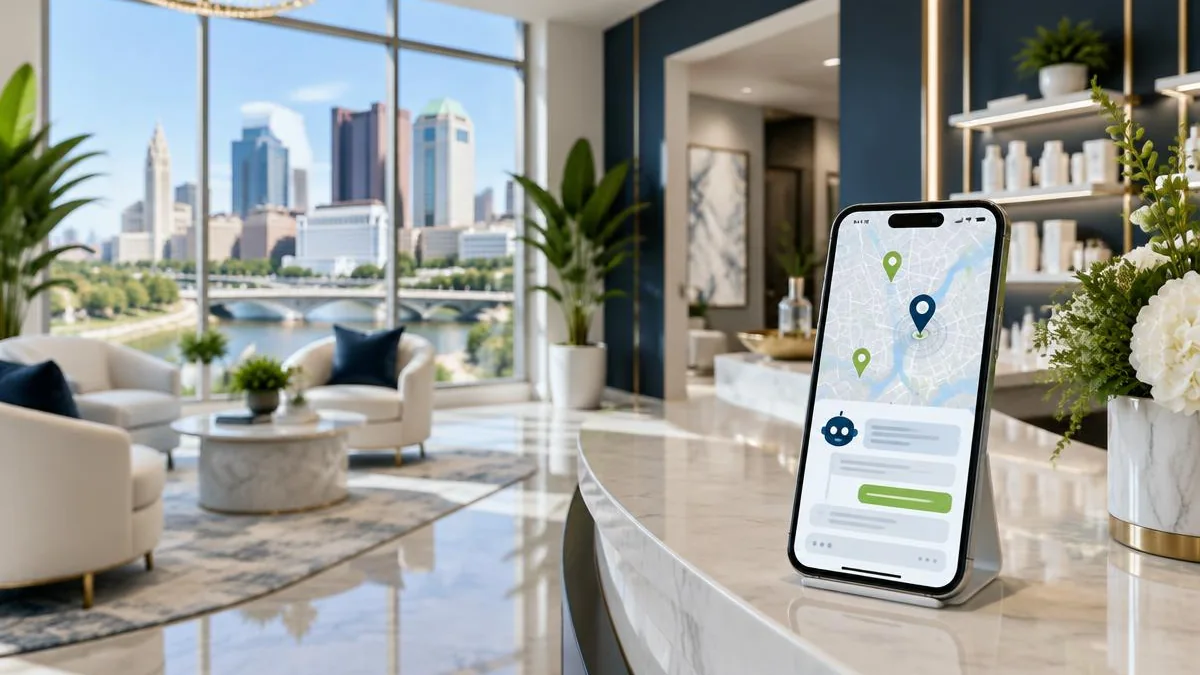
- How local SEO and AEO work together
- Build a reliable local-search foundation
- Create treatment pages that answer real questions
- Optimize your Google Business Profile
- Turn reviews into useful trust signals
- Publish Columbus content without doorway pages
- Strengthen technical SEO and structured data
- Measure leads, not vanity rankings
- A practical 90-day plan
- Frequently asked questions
How Local SEO and AEO Work Together
Local SEO is the work of making a business visible and trustworthy for geographically relevant searches. For a medical spa, those searches may combine a treatment, concern, provider type, or brand with “near me,” Columbus, or a nearby community. The results can include the local map pack, standard organic listings, directories, videos, images, and paid placements.
AEO focuses on whether an answer system can extract a useful, well-supported response from your website and connect it to a real business entity. An answer engine needs to understand basic facts: what the practice offers, who provides care, where it operates, which patients a service may suit, and what limitations or next steps apply. Vague slogans give these systems very little to work with.
The overlap is substantial. Accurate business details support both systems. A page that directly answers “How much downtime follows microneedling?” can help conventional search and AI-generated answers. Provider biographies, location details, treatment relationships, FAQs, and schema all reinforce context. Our Columbus SEO services address discoverability, while our AEO and AI search optimization makes approved information easier for answer engines to interpret.
1. Build a Reliable Local-Search Foundation
Start with identity consistency. The practice name, street address, phone number, primary website URL, hours, and service categories should agree across the website, Google Business Profile, Apple Business Connect, Bing Places, major directories, social profiles, and healthcare or aesthetics listings. Small formatting differences are usually less important than genuinely conflicting information, duplicate profiles, old locations, and disconnected phone numbers.
Create a dedicated location page for every real, staffed location. Each page should include the address, phone number, hours, directions, parking details, accessibility information, provider information, treatments available at that location, original photographs, and an embedded map when useful. If a treatment is offered at one office but not another, say so clearly.
A Columbus-area practice can naturally mention communities it serves—such as Dublin, Westerville, New Albany, Powell, Gahanna, Hilliard, Worthington, and Upper Arlington—without pretending to have an office in each one. Useful service-area content explains travel context, location-specific availability, or genuinely different needs. Thin pages that swap only the city name create a poor experience and can compete against one another.
Finally, make the booking path consistent. Every treatment page should lead to the same current phone number, consultation form, or scheduling flow. Broken forms and conflicting calls to action erase the value of higher rankings. A fast, focused medical spa website design should connect discovery, education, and scheduling without forcing patients through multiple systems.
2. Create Treatment Pages That Answer Real Patient Questions
A list of treatment names is not a search strategy. Each important service needs a page with enough original information to help a prospective patient make a responsible next decision. Begin with a plain-language explanation of the treatment and the concern it is intended to address. Then cover candidacy, consultation, treatment process, expected sensations, downtime, typical treatment cadence, aftercare, limitations, and when another option may be more appropriate.
Use question-based headings where they fit naturally. “How long does treatment take?” is more useful than “Treatment Duration.” Answer the question in the first sentence, then add context. This structure helps hurried readers, featured snippets, voice search, and AI systems that need a concise passage before deciding whether to use a source.
Medical accuracy is essential. AI can assist with drafting, but a qualified provider should review clinical content before it goes live. Avoid universal promises, permanent-result language, and unsupported comparisons. Be precise about who performs the service and the credentials relevant to it. AEO is not permission to mass-produce medical copy; it rewards information that is easy to retrieve, and that makes accuracy more important.
Build relationships between related pages. A neuromodulator page might link to a consultation page, provider biography, pricing or financing information, aftercare guidance, and related skin-quality treatments. These internal links help visitors continue their research and help crawlers understand the site. A broader medical spa marketing strategy should connect those pages to the patient journey rather than treating them as isolated search assets.
3. Optimize Your Google Business Profile for Discovery and Confidence
Your Google Business Profile is often the first complete impression a local patient receives. Choose the most accurate primary category and add relevant secondary categories without stretching beyond the real business. Keep services, hours, appointment links, business description, opening date, and accessibility details current. Upload original images that show the exterior, reception area, treatment rooms, team, and recognizable arrival experience.
Use the profile to remove friction. Patients should be able to confirm the location, understand the general service mix, call, visit the website, and request an appointment. Track the website and appointment URLs so the practice can distinguish profile traffic from other channels.
Google posts can support timely announcements, educational updates, events, and offers, but they do not replace permanent website content. A detailed treatment answer belongs on the website, where it can be maintained, internally linked, and supported with schema. The profile can point to that resource.
Monitor suggested edits, duplicate listings, inaccurate user-submitted information, and questions. Public answers should protect privacy and avoid discussing individual care. For help strengthening local listings and maps visibility, see our Columbus GEO and local visibility services.
4. Turn Reviews Into Useful Trust Signals
Reviews influence patient confidence and can support local prominence, but a med spa should never treat them as a shortcut. Build a consistent process for requesting honest feedback from eligible patients without incentives, pressure, or review gating. Follow the rules that apply to the platform and the practice.
Respond professionally without confirming that a reviewer is a patient or revealing protected information. A safe response can thank the person for the feedback, restate a general service commitment, and invite direct contact. The goal is not to win a public argument. It is to show future readers that concerns receive a calm, responsible response.
Review themes can also guide content. If patients repeatedly praise clear explanations, comfortable visits, easy scheduling, or natural-looking results, those themes may reveal what prospective patients value. If questions repeatedly appear about parking, downtime, financing, or preparation, improve the relevant website pages. Reviews are evidence of experience, not a source for making clinical claims.
Our guide to getting more Google reviews for a med spa explains how to make ethical review requests part of everyday operations.
5. Publish Columbus Content Without Creating Doorway Pages
Strong local content answers a real local question. It might explain how to reach the practice from a nearby area, compare consultation options available at the actual location, announce a community event, introduce a local provider, or address a seasonal concern relevant to Central Ohio. It should still be useful if every neighborhood name were removed.
Avoid publishing dozens of nearly identical pages for suburbs where the practice has no office. Those pages rarely provide distinct value and can dilute the authority of stronger location and treatment pages. Instead, build one authoritative location page and a smaller number of substantial resources tied to real services and local intent.
Use editorial content to answer questions that do not belong on a sales page. Examples include how to compare med spa providers, what credentials to verify, what to ask during a consultation, how seasonal sun exposure affects planning, or how to evaluate downtime before an event. Each article should link to the relevant service and consultation path. Our content marketing services use this question-led approach to support both search visibility and patient education.
6. Strengthen Technical SEO and Structured Data
A search-ready site must be crawlable, fast, mobile-friendly, and logically organized. Every public page needs a unique title, concise description, self-referencing canonical URL, one clear main heading, descriptive image text, and internal links that users can follow. Redirect retired URLs and repair broken links. Submit an accurate XML sitemap and avoid blocking important pages or approved AI crawlers unintentionally.
Structured data helps machines interpret entities and page types. A med spa site may appropriately use LocalBusiness or a more specific business type, Organization, Person for providers, Service, BreadcrumbList, Article, and FAQPage where visible questions and answers exist. Schema must match the page. Marking up claims or reviews that visitors cannot see creates inconsistency rather than authority.
Performance matters because local searches often happen on phones. Compress images, reserve image dimensions to prevent layout movement, limit unnecessary scripts, and keep the booking experience responsive. A custom AI-ready website can build monitoring, scheduling, payment, lead qualification, and reporting directly into the platform while reducing dependence on overlapping plugins.
For AEO, add concise answers near the top of important pages, explain relationships between services, identify providers and locations, and ensure essential information appears as readable page content rather than only inside images or scripts. These steps improve comprehension; no ethical agency can guarantee inclusion in a specific AI answer.
7. Measure Leads, Not Vanity Rankings
Rankings matter only when they contribute to qualified consultations and revenue. Track calls, appointment requests, completed forms, scheduling starts, checkout events, and other approved lead actions. Connect those outcomes to landing pages and traffic sources while respecting privacy and consent requirements.
Review Google Search Console for queries, pages, impressions, clicks, and average position. Use website analytics to understand local landing pages, referral sources, engagement, and conversions. Google Business Profile performance adds directional information about calls, website clicks, and direction requests. None of these systems reveals every private prompt someone typed into an AI assistant, so AI referral reporting should be interpreted alongside landing pages and known search demand.
A monthly review should ask: Which treatment pages are gaining visibility? Which pages receive impressions but few clicks? Which local visits become consultations? Which questions appear in calls and forms? Which technical or content issues need approval? Our model uses ongoing SEO and AEO monitoring to identify safe corrections and surface larger recommendations for review rather than rewriting medical content without oversight.
8. A Practical 90-Day Columbus Med Spa SEO and AEO Plan
Days 1–30: Correct the Foundation
- Audit business information, duplicate listings, analytics, Search Console, sitemap access, and index coverage.
- Confirm one accurate page for every real location and one strong page for every priority treatment.
- Repair broken forms, calls, appointment links, titles, descriptions, headings, image text, and internal links.
- Document provider credentials, service availability, review practices, and approval responsibility for medical content.
Days 31–60: Improve Answers and Local Relevance
- Add direct answers, candidacy information, process details, limitations, FAQs, and next steps to priority treatment pages.
- Complete the Google Business Profile and add current original photography.
- Publish one substantial Columbus resource based on a verified patient question.
- Add accurate Service, Person, Article, FAQPage, and breadcrumb schema only where the visible content supports it.
Days 61–90: Build Authority and Measure Outcomes
- Launch a consistent, compliant process for requesting honest reviews.
- Earn relevant local mentions through partnerships, professional participation, community involvement, and useful expert contributions.
- Review leads by source and landing page, then improve pages with visibility but weak conversion.
- Create a recurring monitoring process for technical SEO, local listings, AEO readiness, content opportunities, and approved updates.
Frequently Asked Questions
What is local SEO for a medical spa?
Local SEO helps a medical spa appear when nearby patients search Google or Maps for treatments, providers, and aesthetic practices. It aligns the website, Google Business Profile, reviews, location signals, and local content around the practice’s real services and service area.
What is AEO for a med spa?
Answer Engine Optimization makes a med spa’s approved information easier for Google AI, ChatGPT, Perplexity, and voice assistants to understand and potentially cite. It uses direct answers, clear service relationships, provider credentials, structured data, and crawlable content.
How long does med spa local SEO take?
Meaningful local SEO improvement usually develops over months, not days. Timing depends on competition, the practice’s starting point, website quality, profile accuracy, review activity, content depth, and how consistently technical problems are corrected.
Can a med spa rank in nearby Columbus suburbs without an office there?
A practice can build organic relevance for nearby communities it genuinely serves, but it should not create fake locations or imply it has offices where it does not. Google Maps proximity remains important, so honest service-area content is the safer long-term strategy.
Do Google reviews help a medical spa appear in AI answers?
Reviews can strengthen local prominence and provide public evidence about patient experience, but they do not guarantee an AI citation. Consistent business information, authoritative service content, provider details, and independent mentions also matter.
Should a med spa use AI to write treatment pages?
AI may assist research and drafting, but treatment content should be reviewed by a qualified provider before publication. Clinical claims, candidacy, risks, downtime, expected outcomes, and aftercare must remain accurate and specific to the practice.
Make Your Med Spa Easier to Find—and Easier to Understand
The strongest Columbus med spa search strategy does not chase a separate trick for every platform. It creates one accurate, useful, technically sound source of truth about the practice, then reinforces that information through local profiles, reviews, authoritative content, structured data, and measurable patient journeys.
The Real Social Company combines local SEO, AEO, medical spa marketing, and high-performance website systems for practices in Columbus and across Central Ohio. Book a free consultation to identify what your website should clarify, automate, and measure next.