
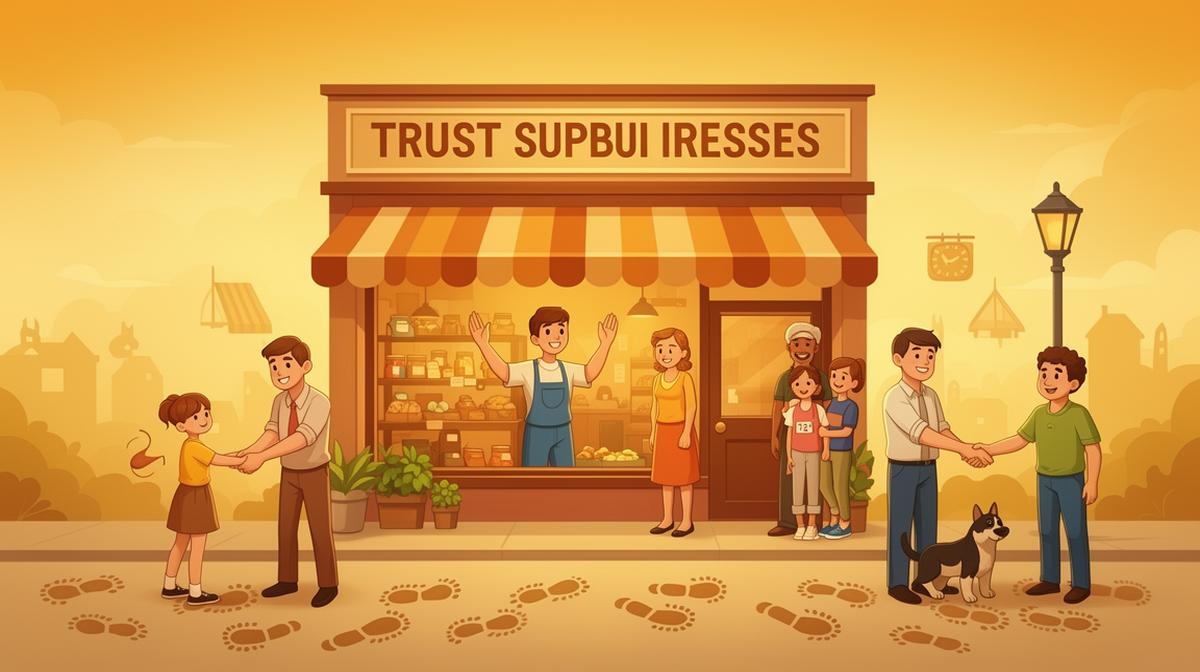
The Psychology of Trust in Local Businesses
*Why "Local" Feels Safer and How to Leverage This for Your Business*
If you've ever wondered why some businesses seem to effortlessly attract loyal customers while others struggle to get a second glance, the answer often comes down to one word: trust.
Trust is the invisible currency of every transaction. It's the reason someone chooses the neighborhood coffee shop over a chain, why they hire the local accountant their neighbor recommended, and why they feel comfortable leaving their car with the mechanic on Main Street. But here's what most business owners don't realize: trust isn't built through better products or lower prices alone. It's built through psychology.
Understanding the psychological mechanisms behind trust formation isn't manipulation—it's empathy in action. When you understand how trust actually forms in the human brain, you can design your business presence to work with these natural patterns rather than against them.
This comprehensive guide explores the four pillars of local business trust: why "local" inherently feels safer, the power of familiarity bias, the science of face recognition and repeated exposure, and the subtle art of community signaling. More importantly, you'll learn exactly how to apply these principles to your About page, team photos, testimonial strategy, and social media presence.
The 4 Pillars of Local Business Trust
Local = Safer
Proximity creates accountability and perceived safety
Familiarity Bias
We trust what we know and recognize
Repeated Exposure
Seeing faces builds subconscious trust
Community Signaling
Shared identity creates instant connection
Trust is the #1 conversion blocker for small businesses—understanding these pillars removes that barrier
---
Pillar 1: Why "Local" Feels Safer
There's a reason your grandmother preferred buying from "Joe down the street" over a catalog. This isn't just nostalgia—it's deep evolutionary programming.
The Proximity-Accountability Connection
When a business is local, there's an implicit understanding: they can't just disappear. The owner has to face you at the grocery store. Their kids might go to school with yours. They're embedded in the same social fabric, which creates natural accountability.
This isn't conscious logic—it's a feeling. And that feeling translates directly into purchasing confidence.
The psychology at work:
How to Leverage This for Your Business
Even if you serve clients nationwide, you can still tap into the "local = safe" psychology:
🏠 Action Items: Emphasize Your Local Roots
- ✓ Include your physical address prominently on your website
- ✓ Mention specific neighborhoods, landmarks, or community events you're part of
- ✓ Use local imagery in your marketing—recognizable streets, buildings, or scenery
- ✓ Share your business origin story tied to the local area
💡 How We Can Help: Our WordPress AI Website Design service includes strategic local SEO elements that signal your community presence to both search engines and visitors.
---
Pillar 2: The Power of Familiarity Bias
Familiarity bias is one of the most powerful forces in human psychology. Simply put: we trust what we know.
This bias operates below conscious awareness. You don't think "I recognize that logo, therefore I should trust this company." Instead, you simply *feel* more comfortable—without knowing why.
The Science Behind Familiarity
Psychologist Robert Zajonc demonstrated this effect in his famous "mere exposure" studies. Participants who were shown nonsense words or random shapes repeatedly rated them as more positive than ones they saw less frequently. The items didn't become objectively better—they just became *familiar*, and familiar feels good.
For local businesses, this means:
The Recognition Hierarchy
Trust builds in layers. Here's how familiarity compounds:
Each layer makes the next transaction more likely.
🎯 Action Items: Build Familiarity Strategically
- ✓ Maintain consistent branding across all platforms—same colors, fonts, and tone
- ✓ Show up regularly in local spaces (both digital and physical)
- ✓ Create content that keeps you top-of-mind without being salesy
- ✓ Sponsor local events, teams, or causes for visibility
💡 How We Can Help: Our Content Marketing service creates consistent, strategic content that builds familiarity with your target audience over time—turning strangers into recognizers into customers.
---
Pillar 3: Face Recognition & Repeated Exposure
Here's a truth that many business owners overlook: people don't trust businesses. People trust people.
Your face—and the faces of your team—are the most powerful trust-building assets you have. This isn't vanity; it's neuroscience.
The Fusiform Face Area
The human brain has a specialized region called the fusiform face area (FFA) dedicated entirely to processing faces. We're wired to recognize faces faster than almost anything else—and to form judgments about trustworthiness within milliseconds.
When someone sees a face associated with your business, something profound happens:
The Mere Exposure Effect in Action
Remember Zajonc's research on familiarity? It applies even more powerfully to faces. Each time someone sees your face (or your team's faces), they become slightly more comfortable, slightly more trusting, slightly more likely to do business with you.
This is why:
Strategic Team Photo Placement
Your team photos aren't just "nice to have"—they're conversion tools. Here's where they matter most:
High-impact placements:
📸 Action Items: Optimize Your Visual Presence
- ✓ Invest in professional headshots for your team—this isn't the place to cut corners
- ✓ Include candid "in action" photos alongside formal headshots
- ✓ Show faces consistently across all marketing channels
- ✓ Update photos regularly—outdated photos can backfire when clients meet you
- ✓ Use video content to multiply the exposure effect
💡 How We Can Help: We design About pages that strategically feature your team in ways that build trust fast. Our approach combines professional photography with storytelling that humanizes your brand.
---
Pillar 4: Community Signaling
Humans are tribal. We evolved in small groups where belonging meant survival. Today, we still gravitate toward people and businesses that signal "we're part of your tribe."
Community signaling is the art of demonstrating shared identity, values, and belonging.
What Community Signals Communicate
When you display community involvement effectively, you're saying:
These signals bypass logical evaluation and speak directly to the tribal brain.
Types of Community Signals
Geographic signals:
Value signals:
Relationship signals:
Testimonial Placement Strategy
Testimonials are community signals on steroids. They combine social proof, familiarity (when the reviewer is known), and community belonging in one powerful package.
But placement matters enormously:
Strategic testimonial placement:
🤝 Action Items: Signal Community Belonging
- ✓ Collect testimonials that mention specific local context when possible
- ✓ Feature reviews from recognizable community members prominently
- ✓ Create content about local events, issues, and celebrations
- ✓ Partner with complementary local businesses for cross-promotion
- ✓ Document your community involvement through photos and stories
💡 How We Can Help: Our Local SEO services include reputation management and review strategy that builds powerful social proof from your community.
---
Putting It All Together: A Trust-Building Audit
Now that you understand the four pillars, it's time to audit your current presence. Ask yourself these questions:
About Page Audit
Website Overall
Social Media Presence
---
The Compound Effect of Trust
Here's the beautiful thing about trust-building: it compounds.
Each time someone sees your face, you become more familiar. Each community signal reinforces the others. Each positive interaction makes the next one more likely. Trust doesn't build linearly—it builds exponentially once you reach critical mass.
The businesses that understand this don't just survive—they become fixtures of their communities. They become the "obvious choice." They stop competing on price and start competing on relationship.
And it all starts with understanding the psychology.
---
Key Takeaways
📌 Remember These Trust Principles
- "Local" = Safe: Proximity creates accountability. Emphasize your physical presence and community ties.
- Familiarity breeds trust: Consistent visibility across channels builds subconscious comfort.
- Faces build connection: People trust people, not logos. Strategic face placement accelerates trust.
- Community signals matter: Demonstrating shared identity and values triggers tribal belonging instincts.
- Trust compounds: Each signal reinforces the others. Consistency over time creates exponential returns.
Trust is the #1 conversion blocker for small businesses. But it's also the ultimate competitive advantage for those who understand how to build it. By applying these psychological principles to your About page, team photos, testimonial placement, and social media presence, you're not manipulating anyone—you're simply communicating your trustworthiness in the language the human brain naturally understands.
---
*The Real Social Company is a Columbus-based digital marketing agency specializing in AI Website Design, SEO, and social media management for local businesses across Ohio. Contact us today to learn how we can help your business build the trust that drives growth.*